

Terminology
- ITA — Income Tax Act (소득세법), Act No. 21548
- ITA ED — Enforcement Decree of the Income Tax Act (소득세법 시행령), Presidential Decree No. 36343
- RSTA — Restriction of Special Taxation Act (조세특례제한법), Act No. 21612
- Year-end settlement (연말정산) — the February reconciliation your employer performs on your Korean salary. It is not an annual tax return; it replaces one for most employees.
1. Question
I moved to Korea on 10 August 2026 to join the Korean subsidiary of my employer. My contract runs for two years. My Korean salary for August through December will be about 50 million won.
I still own an apartment in my home country that is rented out. The rent is paid into my bank account there and I have not sent any of it to Korea.
Our HR team told me I will go through "year-end settlement" in February. But I have only been in Korea for about five months this year, which is less than 183 days. I understood that makes me a non-resident. Am I a resident or not, and does Korea tax the rent on my apartment back home?
📌 The short answer
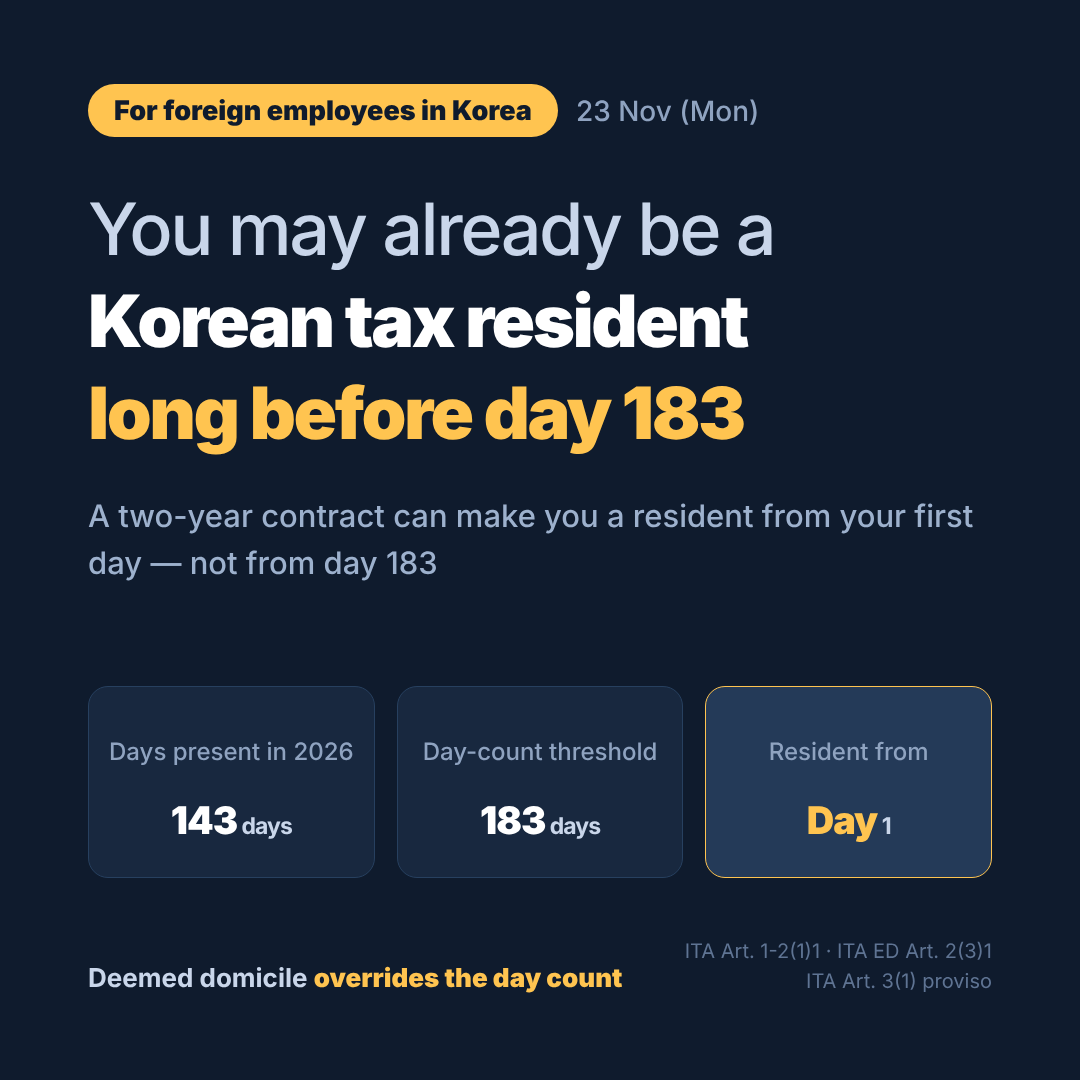
You are almost certainly a Korean tax resident from 10 August 2026, your first day in Korea — not from day 183. A two-year employment contract is an occupation that ordinarily requires residing in Korea for 183 days or more, and ITA ED Article 2(3)1 treats a person in that position as having a domicile in Korea.
The 183-day count is only one of two tests, and it is the one that applies when the other does not. The primary test is domicile, which is decided on objective facts about your life — where the family sharing your livelihood lives, where your assets are, and what your job requires (ITA ED Article 2(1)). Counting days matters for someone whose circumstances do not establish a domicile. It does not override a domicile that already exists.
The rent on your home-country apartment is very likely not taxable in Korea this year. Residents are taxed on worldwide income, but ITA Article 3(1) contains a proviso for foreign residents: if your periods of domicile or residence in Korea total five years or less within the ten years before the end of the tax year, foreign-source income is taxed only to the extent it is paid in Korea or remitted to Korea. You have just arrived and you have not remitted the rent.
Being a resident is good news for your February settlement. Residents claim the full range of deductions. Non-residents are barred by ITA Article 122(1) from claiming personal deductions for anyone other than themselves, special income deductions, the child tax credit, and the special tax credits.
The detailed basis and the judgment points are set out below.
2. Facts and Issues
A. Facts
| Item | Detail |
|---|---|
| Arrival in Korea | 10 August 2026 |
| Employment | Korean subsidiary, two-year contract |
| Korean salary (Aug–Dec 2026) | Approx. KRW 50 million |
| Days of presence in 2026 | Approx. 143 days |
| Foreign-source income | Rental income on a home-country apartment, received abroad, not remitted |
| Prior ties to Korea | None |
B. Issues
① Is the taxpayer a resident or a non-resident for the 2026 tax year, and from which date?
② How are days of presence actually counted, and does falling short of 183 days settle the question?
③ Does Korea tax the home-country rental income?
④ Does a foreign employee go through year-end settlement, does the answer change for a non-resident, and when does the settlement fail to close the year?
⑤ What relief is lost if a person is treated as a non-resident, and what does the 19% flat-rate election for foreign workers cost?
3. Relevant Provisions
Statutory text follows. Readers who do not need it may skip to Section 4.
▸ Issues ①·② Residence — ITA Articles 1-2, 2; ITA ED Articles 2, 2-2, 4 — click to open the statutory text
ITA Article 1-2 (Definitions) (1) The terms used in this Act shall be defined as follows:
1. The term "resident" means an individual who has his/her domicile in the Republic of Korea or has had his/her place of residence in the Republic of Korea for 183 days or longer;
2. The term "non-resident" means an individual other than a resident;
(2) The classification of domiciles and places of residence, and of residents and non-residents under paragraph (1) shall be prescribed by Presidential Decree.
ITA Article 2 (Tax Liability) (1) Any of the following individuals shall be liable to pay income tax on his/her income under this Act:
1. A resident;
2. A non-resident who has income derived from sources in the Republic of Korea.
ITA ED Article 2 (Determination of Domicile and Place of Residence) (1) A domicile under Article 1-2 of the Income Tax Act shall be determined based on objective facts of living relationships, such as the existence of a family sharing a livelihood in the Republic of Korea and of assets located in the Republic of Korea.
(2) A place of residence under Article 1-2 of the Act shall be a place, other than a domicile, where a person has resided for a considerable period but where general living relationships as close as those of a domicile have not been formed.
(3) Where an individual residing in the Republic of Korea falls under any of the following, he/she shall be deemed to have a domicile in the Republic of Korea:
1. Where he/she has an occupation that ordinarily requires residing in the Republic of Korea for 183 days or longer on a continuing basis;
2. Where he/she has a family living together in the Republic of Korea and is recognized as likely to reside in the Republic of Korea for 183 days or longer on a continuing basis in light of his/her occupation and asset position.
ITA ED Article 2-2 (Timing of Becoming a Resident or Non-resident) (1) The time when a non-resident becomes a resident shall be any of the following:
1. The date on which he/she acquires a domicile in the Republic of Korea;
2. The date on which grounds arise for being deemed to have a domicile in the Republic of Korea under Article 2 (3) and (5);
3. The date on which the period of having a place of residence in the Republic of Korea reaches 183 days.
ITA ED Article 4 (Computation of Period of Residence) (1) The period of having a place of residence in the Republic of Korea shall run from the day following the date of entry to the date of departure.
(3) Where the period of having a place of residence in the Republic of Korea falls under any of the following, the individual shall be deemed to have had a place of residence in the Republic of Korea for 183 days or longer:
1. Where the period is 183 days or longer during one tax period;
2. Where the period is 183 days or longer continuously over two tax periods.
▸ Issue ③ Scope of taxable income — ITA Article 3 — click to open the statutory text
ITA Article 3 (Scope of Taxable Income) (1) Income tax shall be imposed on all income prescribed in this Act with respect to a resident. Provided, that with respect to a foreign resident whose periods of having a domicile or place of residence in the Republic of Korea total five years or less within ten years prior to the end of the relevant tax period, income tax shall be imposed only on income paid in the Republic of Korea or remitted to the Republic of Korea, among income generated outside the Republic of Korea.
(2) Income tax shall be imposed on a non-resident only with respect to income derived from sources in the Republic of Korea under Article 119.
▸ Issues ④·⑤ Year-end settlement and the deductions available — ITA Articles 137, 73, 121, 122 — click to open the statutory text
ITA Article 137 (Year-end Settlement of Tax Amount on Earned Income) (1) When paying earned income for February of the year following the relevant tax period, or earned income for the month in which a retiree retires, a person liable for withholding shall withhold income tax calculated in the following order:
1. Calculating the tax base of global income by applying the global income deductions, in accordance with the details reported by the earned income earner under Article 140, to the amount of earned income of the earned income earner for the relevant tax period;
2. Calculating the computed amount of global income tax by applying the basic tax rates to the tax base of global income under subparagraph 1;
3. Calculating income tax by deducting, from the computed amount of global income tax under subparagraph 2, the tax amount withheld under Article 134 (1) during the relevant tax period, the foreign tax credit, the earned income tax credit, the child tax credit, the pension account tax credit, and the tax amount deducted under the special tax credits.
ITA Article 73 (Exceptions to Final Return on Tax Base) (1) Any of the following residents may, notwithstanding Articles 70 and 71, choose not to file a final return on the tax base with respect to the relevant income:
1. A person who has only earned income;
…
(3) Paragraph (1) shall not apply to a person who has earned income falling under the items of Article 127 (1) 4, or retirement income falling under the proviso to subparagraph 7 of the same paragraph. Provided, that this shall not apply to a person who has paid income tax by withholding in accordance with Articles 137, 137-2 and 138 pursuant to Article 152 (2).
ITA Article 121 (Taxation Methods for Non-residents) (3) A non-resident who has no domestic place of business shall be taxed separately on each category of income under the subparagraphs of Article 119 (excluding subparagraphs 8 and 9).
ITA Article 122 (Computation of Tax Base and Tax Amount upon Global Taxation of Non-residents) (1) The provisions of this Act concerning the computation of the tax base and tax amount of income tax on residents shall apply mutatis mutandis to the computation of the tax base and tax amount of income tax on income of non-residents prescribed in Article 121 (2) or (5). Provided, that the personal deductions under Article 51 (3) for persons other than the non-resident himself/herself, the special income deductions under Article 52, the child tax credit under Article 59-2, and the special tax credits under Article 59-4 shall not be allowed.
▸ Issue ⑤ The flat-rate election — RSTA Article 18-2; RSTA ED Article 16-2 — click to open the statutory text
RSTA Article 18-2 (Special Taxation for Foreign Workers) (2) Where a foreign executive or employee (excluding daily workers; hereinafter "foreign worker") first begins to provide labour in the Republic of Korea on or before 31 December 2026, income tax on earned income received by working in the Republic of Korea [excluding cases of providing labour to a specially related person prescribed by Presidential Decree (hereinafter "specially related enterprise") other than a foreign-invested company prescribed by Presidential Decree], being earned income received up to the tax period ending within 20 years from the date on which labour was first provided in the Republic of Korea, may, notwithstanding Article 55 (1) of the Income Tax Act, be the amount calculated by multiplying such earned income by 19/100. …
(3) In applying paragraph (2), the provisions concerning non-taxation (excluding non-taxation of income prescribed by Presidential Decree among benefits of a welfare nature under Article 12 (3) (저) of the Income Tax Act), deductions, reductions and tax credits relating to income tax under the Income Tax Act and this Act shall not apply, and such earned income shall not be aggregated into the global income tax base under Article 14 (2) of the Income Tax Act.
(4) A person liable for withholding may, notwithstanding Article 134 (1) of the Income Tax Act, withhold the amount calculated by multiplying the earned income by 19/100 when paying monthly earned income to a foreign worker.
(5) A foreign worker who intends to be subject to paragraph (2) or (4) shall file an application as prescribed by Presidential Decree.
RSTA ED Article 16-2 (Special Taxation for Foreign Workers) (2) The term "specially related person prescribed by Presidential Decree" in the main clause of Article 18-2 (2) of the Act means an enterprise standing in a relationship of kinship under Article 1-2 (1) of the Enforcement Decree of the Framework Act on National Taxes, or of managerial control under paragraph (3) of the same Article, with the enterprise to which the foreign worker provides labour. …
(4) A foreign worker who intends to be subject to Article 18-2 (2) of the Act (limited to a person who does not hold the nationality of the Republic of Korea as at the end of the relevant tax year) shall, at the time of the year-end settlement of tax on earned income or of the final return on the global income tax base, attach the flat-rate application form for foreign workers prescribed by Ministerial Ordinance to the earned income earner's income and tax credit report under Article 198 (1) of the Enforcement Decree of the Income Tax Act, and submit it to the person liable for withholding, the taxpayers' association or the head of the competent district tax office.
(5) The term "income prescribed by Presidential Decree" in Article 18-2 (3) of the Act means the income under subparagraph 1 of Article 17-4 of the Enforcement Decree of the Income Tax Act.
(6) A foreign worker who intends to be subject to Article 18-2 (4) of the Act (limited to a person who does not hold the nationality of the Republic of Korea as at the date of the withholding application) shall submit the flat-rate withholding application form prescribed by Ministerial Ordinance, through the person liable for withholding, to the head of the district tax office having jurisdiction over withholding, by the 10th day of the month following the month in which the labour was provided.
4. Analysis
A few terms first.
- Domicile (주소) — not an address on a document. ITA ED Article 2(1) decides it on objective facts about your life: where the family sharing your livelihood lives, where your assets are, what your job requires.
- Place of residence (거소) — somewhere you stay for a considerable time without forming the close living ties of a domicile. This is the concept the 183-day count attaches to.
- Tax period (과세기간) — the Korean tax year, which is always 1 January to 31 December. It does not follow your arrival date.
- Foreign-source income (국외원천소득) — income generated outside Korea. For a foreign resident in the first years in Korea, this is the category the Article 3(1) proviso narrows.
A. The numbers first — 143 days, and it does not matter
Count the days on the statutory basis. ITA ED Article 4(1) runs the period from the day following entry to the date of departure, so 10 August does not count.
| Period | Days |
|---|---|
| 11–31 August | 21 |
| September | 30 |
| October | 31 |
| November | 30 |
| December | 31 |
| Total for 2026 | 143 |
143 days is short of 183. On the residence-period test alone, you would be a non-resident for 2026.
That test is not reached here. ITA ED Article 2(3)1 deems a person to have a domicile in Korea where he has an occupation that ordinarily requires residing in Korea for 183 days or longer on a continuing basis. A two-year employment contract with a Korean entity is such an occupation. Once a domicile is deemed, ITA Article 1-2(1)1 makes you a resident, and the day count becomes irrelevant.
ITA ED Article 2-2(1)2 then fixes the date: you become a resident on the date the grounds for the deemed domicile arise. For a foreign employee that is ordinarily the date of entry to take up the post — 10 August 2026 — not 183 days later and not 1 January 2027.
The practical consequence is that your entire 2026 Korean salary is resident income and your employer settles it in February 2027.
B. Why the 183-day rule is so widely misread
The misunderstanding is understandable. Many countries use a day-count as the primary test. Korea does not. ITA Article 1-2(1)1 is written in the alternative: a resident is someone who either has a domicile or has had a place of residence for 183 days or longer. Domicile comes first in the sentence and first in the analysis.
So the day-count decides residence only for people whose circumstances do not establish a domicile — someone on a series of short assignments, a visiting researcher without a Korean contract, a person whose family and assets stayed abroad and whose Korean stay is not tied to an occupation requiring continued presence.
Two further points on counting, for cases where the count does matter.
ITA ED Article 4(3)2 treats 183 days or longer continuously over two tax periods as satisfying the test. So a stay beginning in October 2026 and continuing past mid-April 2027 can make you a resident even though neither calendar year alone reaches 183 days.
ITA ED Article 4(2) provides that where a person who has had a place of residence in Korea departs and re-enters, and the purpose of the departure is recognised as clearly temporary — tourism, medical treatment and similar grounds prescribed by Ministerial Ordinance, judged in light of where the family sharing his livelihood resides and where his assets are located — the period spent abroad is still counted as a period of residence in Korea. Short trips home do not reset the clock, though the provision turns on the purpose of the trip rather than on its length.
C. Your home-country rent is probably outside Korean tax this year
Residents are taxed on worldwide income (ITA Article 3(1), main text). That sentence alone would bring your foreign rental income into Korean tax.
The proviso narrows it. For a foreign resident whose periods of domicile or residence in Korea total five years or less within the ten years before the end of the tax period, foreign-source income is taxed only on amounts paid in Korea or remitted to Korea.
| Your situation | Treatment |
|---|---|
| Rent received into a home-country account, not remitted | Not taxed in Korea while the proviso applies |
| Rent remitted to your Korean account | Taxed in Korea to the extent remitted |
| Salary paid by the Korean subsidiary | Taxed in full — this is Korean-source income, not foreign-source |
Three cautions. The relief turns on the five-year count, so it is temporary; once your accumulated years in Korea pass five within the preceding ten, worldwide taxation applies in full. The proviso covers foreign-source income only, so it does nothing for your Korean salary. And it does not extinguish your home country's own taxing rights, which are governed by that country's law and by the tax treaty with Korea.
Whether a particular receipt is foreign-source, and whether a transfer into Korea counts as a remittance of that income rather than of savings, can be contested in practice. Where the amounts are significant, this is worth confirming with your tax adviser or the district tax office before the February settlement rather than after.
D. Foreign employees do go through year-end settlement
Year-end settlement is not a residents-only procedure. It attaches to Korean-source earned income.
Employment income of a non-resident is Korean-source income under ITA Article 119(7) where the work is performed in Korea. ITA Article 156(1), which sets up separate withholding at flat rates for non-residents, lists Article 119 subparagraphs 1, 2, 4 to 6 and 9 to 12 — subparagraph 7 is not among them. Employment income therefore stays with the ordinary withholding machinery in ITA Article 127 and is settled under ITA Article 137 in the same way as for a resident.
So whether you are a resident or a non-resident, your employer runs a February settlement on your Korean salary. The difference is not whether it happens. The difference is what you may claim in it.
Two mechanics of that settlement are worth knowing, because foreign employees run into both.
The settlement applies the deductions you report. ITA Article 137(1)1 computes the tax base by applying the global income deductions "in accordance with the details reported by the earned income earner under Article 140" — that is, the deduction report you hand to payroll. If you file nothing, ITA Article 137(3) limits the employer to the basic deduction for yourself and the standard tax credit. Nobody claims your dependants for you.
And if the settlement produces tax to pay rather than a refund, ITA Article 137(4) lets the employer spread an additional amount over KRW 100,000 across the February, March and April payrolls, at the employer's option. A February underpayment is not necessarily a single-month hit.
One limit on all of this deserves a flag, because it catches foreign employees more often than anyone else. The February settlement substitutes for a tax return only because ITA Article 73(1)1 excuses a resident with employment income alone from filing. ITA Article 73(3) takes that exemption away for a person with employment income falling under the subparagraphs of ITA Article 127(1)4 — broadly, employment income paid from outside Korea, on which no Korean withholding is made. If part of your package is paid or delivered by an overseas parent rather than by your Korean employer, the February settlement may not close your year, and a May global income tax return may be required. Whether that applies to a particular item of overseas-paid compensation turns on facts the payroll file does not always show, so it is worth asking the question in advance rather than discovering it in May.
E. What non-resident status — and the flat rate — would cost you
The statutory restriction sits in the proviso to ITA Article 122(1), which removes four blocks of relief from a non-resident.
| Relief | Resident | Non-resident |
|---|---|---|
| Basic deduction for yourself (KRW 1.5 million) | Yes | Yes |
| Deductions for spouse and dependants | Yes | No |
| Additional personal deductions (elderly, disabled, etc.) for others | Yes | No |
| Special income deductions — housing lease repayments, long-term mortgage interest (ITA Article 52) | Yes | No |
| Child tax credit (ITA Article 59-2) | Yes | No |
| Special tax credits — medical, education, insurance, donations (ITA Article 59-4) | Yes | No |
For an employee with a non-working spouse, children, or Korean housing finance, the gap is substantial. This is why the residence question is worth settling before February rather than assuming the day-count answer.
One technical note, since this blog does not paper over gaps. Article 122 is written for a non-resident taxed on a global basis under Article 121(2) or (5). A non-resident employee with no domestic place of business is taxed separately by income category under Article 121(3), and the Act does not expressly carry the Article 122(1) proviso across to the February settlement in that case. In practice the restriction is applied to a non-resident's year-end settlement all the same, and that is the position payroll systems and the tax office work from. The practical message is the same either way: if you have dependants or housing deductions to claim, establish resident status rather than relying on how a non-resident settlement is run.
One point in the other direction, so the picture is complete, and it is time-sensitive.
RSTA Article 18-2(2) lets a foreign executive or employee elect to have Korean earned income taxed at a flat 19% instead of the progressive rates in ITA Article 55(1). Two conditions matter most. The employee must have first begun providing labour in Korea on or before 31 December 2026, and the relief then runs to the tax period ending within 20 years of that first day. Earned income from working for a prescribed specially related enterprise is excluded, subject to a carve-out for prescribed foreign-invested companies.
If you started work in Korea during 2026, you are inside the entry window as the statute currently stands. Someone starting in 2027 is not, unless the sunset is extended. That is a reason to settle the question now rather than in February.
The price is steep. RSTA Article 18-2(3) switches off the non-taxation, deduction, reduction and tax credit provisions of the Income Tax Act and the RSTA, and keeps the income out of the global income tax base under ITA Article 14(2). Electing the flat rate therefore means giving up dependant deductions, housing deductions, medical and education credits, pension account credits, and the card deduction, all of them.
The sole carve-out is narrow. Article 18-2(3) preserves non-taxation of "income prescribed by Presidential Decree" among the welfare-type benefits in ITA Article 12, subparagraph 3, item (저), and RSTA ED Article 16-2(5) identifies that income as the item in ITA ED Article 17-4(1) alone — the benefit an employee or non-shareholder executive derives from being provided with company housing. Nothing else in that welfare-benefit list survives the election.
Two procedural points, both with deadlines. To have the flat rate applied in the settlement itself, RSTA ED Article 16-2(4) requires you to attach the prescribed flat-rate application form for foreign workers to your deduction report at the time of the year-end settlement or the final return, and to file it with the withholding agent, the taxpayers' association or the district tax office. To have 19% withheld monthly instead, RSTA ED Article 16-2(6) requires a separate withholding application by the 10th day of the month following the month in which the labour was provided, submitted through the withholding agent. Either way the applicant must not hold Korean nationality — as at the end of the tax year for the settlement route, and as at the application date for the monthly route. Whether the flat rate beats progressive taxation depends on your salary and on how much deduction you would otherwise actually use, so it has to be calculated both ways — not assumed from the headline rate.
F. What to do before the settlement
- Settle your residence status in writing with HR now. If your contract is for a year or more, say so. Payroll systems sometimes default a new foreign hire to non-resident treatment on the day count, which produces the wrong February outcome.
- Keep your entry and departure record. Where the day count does matter, the immigration record is the evidence. Note that the count starts the day after entry.
- Do not remit foreign-source income to Korea without thinking about it. While the Article 3(1) proviso applies to you, a remittance is what brings that income into Korean tax.
- Decide the flat-rate question on a calculation. Gather what you would claim as a resident — dependants, housing, pension contributions, insurance — before comparing.
- File the deduction report with payroll. Under ITA Article 137(1)1 the settlement applies what you report; under Article 137(3), reporting nothing leaves you with the basic deduction for yourself and the standard tax credit.
- Gather dependant documentation early if you are claiming family abroad. Family relationship certificates issued overseas generally need translation and authentication, which takes longer than the February deadline allows if started in January.
- Check whether anything in your package is paid from outside Korea. If so, ask now whether ITA Article 73(3) leaves you with a May return to make.
- Keep your home-country filing in view. Korean residence does not end your obligations there, and relief from double taxation runs through the foreign tax credit in ITA Article 57 and the applicable treaty.
5. Conclusion
Korean tax residence is established by domicile or a place of residence of 183 days or longer (ITA Article 1-2(1)1), and domicile is decided on the objective facts of a person's living relationships (ITA ED Article 2(1)). A foreign employee holding a contract that ordinarily requires continued presence in Korea for 183 days or more is deemed to have a domicile here (ITA ED Article 2(3)1) and becomes a resident on the date those grounds arise (ITA ED Article 2-2(1)2) — in the ordinary case, the first day of the assignment. Residents are taxed on worldwide income, but a foreign resident with five years or less of Korean domicile or residence within the preceding ten years is taxed on foreign-source income only to the extent it is paid in Korea or remitted here (ITA Article 3(1) proviso). Korean-source employment income is settled by the employer each February under ITA Article 137 for residents and non-residents alike.
The outcome will not match expectations in the following situations.
- Assuming non-resident status because 183 days have not passed — the day count applies only where no domicile is established. A long-term employment contract ordinarily establishes one.
- Counting the date of entry as day one — the period runs from the day following entry (ITA ED Article 4(1)).
- Assuming each calendar year is counted separately — 183 days or longer running continuously across two tax periods also satisfies the test (ITA ED Article 4(3)2).
- Remitting foreign-source income to Korea — the Article 3(1) proviso shelters foreign-source income only while it is neither paid in Korea nor remitted here.
- Expecting the five-year shelter to be permanent — once accumulated Korean domicile or residence exceeds five years within the preceding ten, worldwide taxation applies in full.
- Being treated as a non-resident in the February settlement — deductions for dependants, special income deductions, the child tax credit and the special tax credits are all denied (ITA Article 122(1) proviso).
- Electing the 19% flat rate without calculating it — RSTA Article 18-2(3) switches off non-taxation, deductions, reductions and tax credits for the employee who elects it, so the headline rate is not the comparison.
- Assuming the flat-rate election will still be available next year — as the statute currently stands, it requires labour first provided in Korea on or before 31 December 2026 (RSTA Article 18-2(2)).
- Expecting the flat rate to apply without an application — it must be applied for on the prescribed form, attached to the deduction report at the settlement (RSTA ED Article 16-2(4)), or, for monthly 19% withholding, filed by the 10th of the following month (paragraph (6)).
- Filing no deduction report with payroll — ITA Article 137(3) then limits the settlement to the basic deduction for yourself and the standard tax credit, whatever you were entitled to claim.
- Assuming the February settlement always closes your year — ITA Article 73(3) withdraws the filing exemption where employment income falls under the items of ITA Article 127(1)4, which commonly covers compensation paid from outside Korea, leaving a May return to be made.
Residence in Korea is a question about your circumstances, not about a number of days. For most foreign employees on a one-year or longer contract, residence begins on the first day of the assignment, and the February settlement is where that fact either works for you or against you. Confirm your status with your employer before the payroll run, not after it.
※ Disclaimer
This post is provided for general informational purposes only and does not constitute tax advice on any specific matter. Conclusions may differ depending on the particular facts of an individual case, so please consult a qualified tax professional before acting. The author accepts no liability for any loss arising from decisions made in reliance on this post.
'외국인 비거주자' 카테고리의 다른 글
내 상황에도 해당하는지 확인이 필요하신가요?
율전세무회계컨설팅 세무사 김지현이 사실관계를 확인하고 안내합니다.
이 글은 작성일 현재 법령을 기준으로 한 일반적인 안내이며, 개별 사실관계에 따라 결론이 달라질 수 있습니다. 댓글에 주민등록번호, 계좌번호 등 개인정보를 적지 마십시오.